Certain posters hang on a wall, but others pulse. They shimmer, they flicker, and move infinitesimally, drawing the eye like something living. On the web, static imagery is being replaced by subtle animation — the sort of thing that captures the essence of a held breath or silent heartbeat. Micro-movements, ambient loops, and soft texture flows are redefining what a “poster” can do.
With Dreamina and its AI photo generator, designers can now craft these living visuals — where stillness isn’t the conclusion, but the initial rhythm. It’s not a chaotic movement or streaking lights, but bringing life to design — creating posters that whisper rather than scream, that evoke emotion even when they barely stir at all.
When stillness meets movement
The next generation of posters exists in a liminal state between image and movement. These designs neutralize the divisions of what’s static and what’s alive. A flash of reflection against glass. A gradually changing hue. A thread of digital texture that drifts like smoke. These aren’t bugs — they’re feelings.
Why is this transition occurring? Because our screens are no longer static. What we watch — from the visuals on social media to the digital billboards — moves, responds, and glows. Still posters, the long-reigning kings of visual narrative, now fight for attention against a world accustomed to movement. The answer? Posters that breathe.
These motion-enriched images are built on three pillars of design:
-
Subtlety: The most effective motion posters aren’t distracting — they bewitch.
-
Texture: Movement is suggested by grain, ripple, or moving light.
-
Emotion: Every loop conveys emotion — anticipation, tranquility, tension, wistfulness.
The charm is not so much in animation per se, but in restraint. Designers are finding it easier to allow their visualizations to move only as much as necessary to keep audiences around.
The poetic science of micro-motion
Motion design in posters is not only visual, but psychological. Our eyes are programmed to be attracted to change. Even the slightest flicker can raise a question, drawing attention to a message or mood.
A poster that subtly moves, however, doesn’t yell for attention; it welcomes it. It creates atmosphere, drawing the viewer into the narrative rather than assaulting them.
This is why brands, event promoters, and producers are leveraging AI tools to merge motion and emotion. Envision a campaign poster that gently distorts like water, or a concert visual that vibrates with glowing light trails. These aren’t merely for show — they’re experiential.
Digital storytelling in motion
The interesting thing is that motion posters have become storytelling devices. Rather than jamming information into a static frame, designers now let pictures breathe. With each passing second, there is added depth — a reveal, a glint, a transformation.
Motion designs can convey what words cannot:
-
Emotional shifts — graduating colors that shift as a brand’s voice changes.
-
Emotional resonance — blinking typography that echoes the beat of a tune.
-
Dimensional storytelling — pulse or distorted textures, implying time or energy.
With a hint of movement, posters can now breathe, respond, and even remember.
Painting motion with Dreamina
Dreamina empowers artists to envision that in-between space — where the frozen comes alive to meet the cinema. It’s not an AI-driven tool; it’s a digital co-creator that converts imagination into motion-ready visuals.
Let us discover how you can breathe life into your poster ideas through Dreamina’s flow.
Step 1: Write a text prompt
Begin by visiting Dreamina and entering a text prompt that describes your intended mood and subtle motion style. Consider light, texture, and atmosphere.
For instance: A dreamy digital poster with a cityscape reflected on water, set with soft vapor streams and gentle gradients that suggest slow motion, movie depth, and muted movement.
A descriptive prompt like this informs Dreamina that your vision isn’t static — it’s alive, layered, and atmospheric.
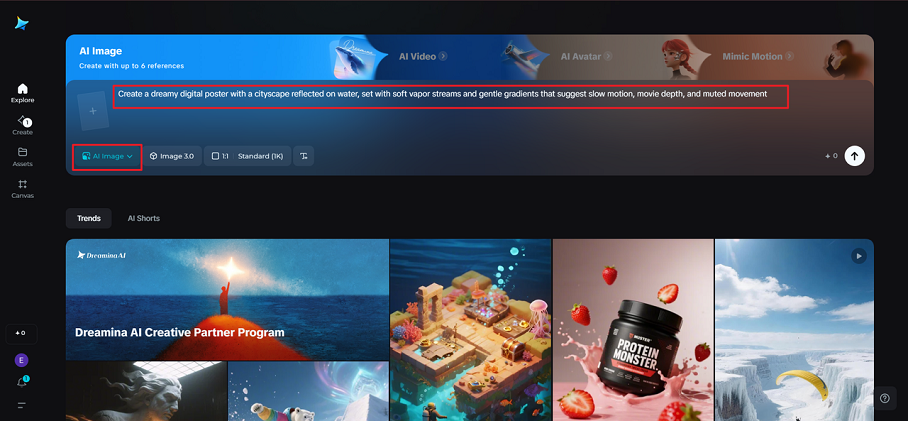
Step 2: Set parameters and generate
When you feel comfortable with your prompt, you may change the model, aspect ratio, size, and resolution (1k or 2k) to fit your project format — a digital ad or a looping website poster. Hit Dreamina’s icon to create your image, and in a few seconds, you have an image base that feels like it is already moving even before the animation starts.
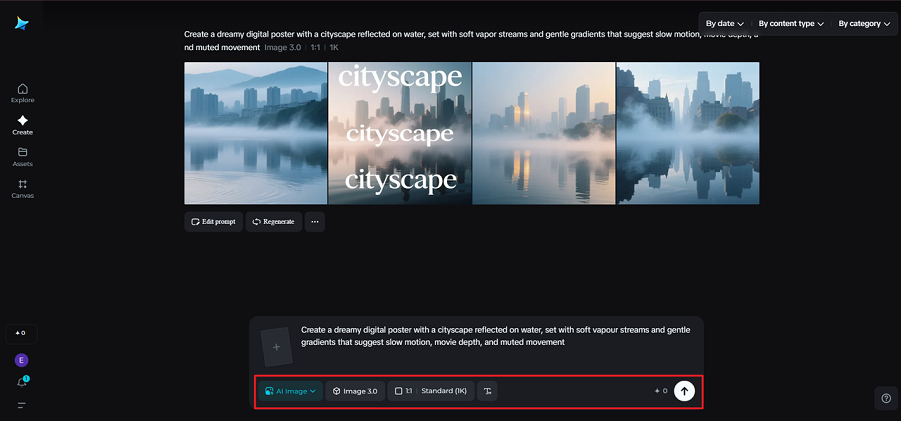
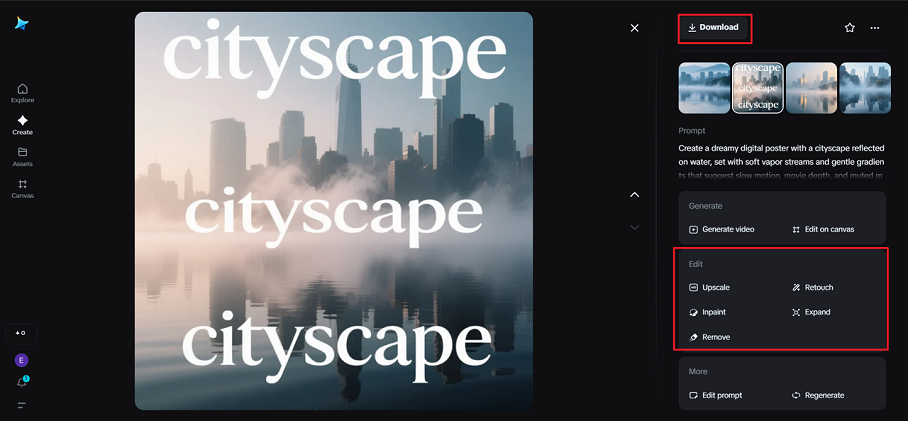
Step 3: Refine and download
Augment your created image with Dreamina’s AI customization features like inpaint, expand, remove, and retouch. It’s here that you finish the rhythm — a subtle reflection, enhance texture flow, or visualize remove noise. When satisfied, click Download to export your design in preparation for layering for animation or digital presentation.
Where posters move audiences
Brands are adopting living posters as motion is what gets remembered — not only visually, but emotionally. The human mind recalls what moves — not merely visually, but on an emotional level too. These changing images are turning up in several spheres:
-
Music events — animated posters that match beats and transitions.
-
Product launches — slow-motion textures that entice brand aesthetics.
-
Film promotions — cinematic teasers that play on repeat on social feeds.
-
Fashion campaigns — moving fabrics and color gradients that suggest energy.
Motion design does not supplant static posters — it amplifies them. It makes each campaign a sensory mini-movie, each ad a living feeling.
AI as the unseen animator
Artificial intelligence has become the quiet co-creator of this new medium. Designers are no longer hand-animating every ripple or flicker; they’re instructing AI to propose motion and energy. For instance, Dreamina’s AI logo generator can infuse movement by way of subtle glow cycles, texture transitions, or lighting loops that cause logos to feel responsive — like they’re within the world they inhabit.
The job of AI isn’t to control design — it’s to assist artists in finding rhythm in quiet. It’s like instructing your poster to breathe by itself.
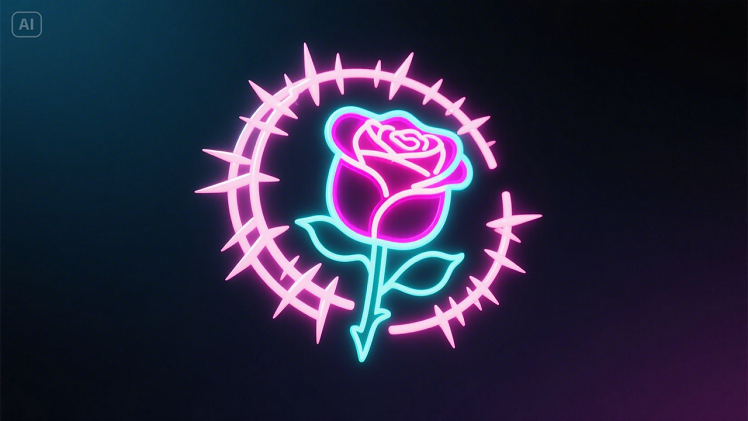
From pixels to presence
A living poster doesn’t occupy space — it occupies presence. With the tools of Dreamina’s AI poster generator, designers can combine light, movement, and emotion into digital images that merge design with performance. These posters might change depending on sound, user input, or even ambient light, fully engaging the viewer.
The beauty is in transformation. A digital poster may begin as a static image, but with the creative nudge of AI, it transforms into an experience that moves — subtly, smartly, infinitely.
The poetry of a breathing image
At its core, movement in static design is a human connection. It’s a reminder that digital art can be made to have a pulse. A flash of light can be perceived as a heartbeat, a changing texture as a sigh. These instances of micro-motion transform design into a feeling — subtle, refined, and haunting.
Conclusion: the art of digital breath
The era of static visuals is gone. Posters are no longer merely looked at — they’re experienced. With the subtle craft of movement, designers are turning static screens into breathing canvases, and artificial intelligence tools such as Dreamina are assisting them in spearheading this revolution.
If you’re making one of those looping ads for social media or maybe a bright concert poster, even a simple brand image, Dreamina takes your flat ideas and makes them come alive like real art that’s moving. Design isn’t static anymore. It has got this beat to it, full of feeling and flow, all working together.
In this fresh wave of creativity, you know, every solid poster really needs that pulse to stand out.