In the world of Outdoor Lighting, the “Autonomy Days” (the number of nights a light can function without sun) is the single most expensive specification. To guarantee 5 days of autonomy instead of 2, engineers typically double the size of the lithium battery and the solar panel. This blows up the budget.
But what if the problem isn’t the storage of energy, but the waste of it?
Many contractors utilizing Solar Lights Street Lights are unknowingly bleeding power through inefficient optical systems. Every photon generated by the LED that doesn’t hit the road represents a fraction of battery life wasted. By optimizing the secondary optics, we can effectively extend the system’s runtime without adding a single amp-hour to the battery. Here is how precision optics act as the ultimate energy saver.
Factor 1: The “Parasitic Loss” of Low Transmission (H2)
The math of solar efficiency is brutal. The energy travels from Battery -> Driver -> LED -> Lens -> Road. The lens is the final gatekeeper.
Standard polycarbonate (PC) lenses often have a light transmittance of around 85-88%. This means 12-15% of your precious battery power is being absorbed by the plastic and turned into heat inside the fixture head.
By upgrading to high-purity optical PMMA (Acrylic) or glass-hybrid materials, transmittance can be boosted to 93-95%.
The Impact: This 7% gain allows the intelligent controller to dim the LED drive current by 7% while maintaining the same lux levels on the ground.
The Result: Over a 12-hour night, this accumulated saving can add up to an extra hour of runtime, critical for surviving long winter nights in Street Lighting applications.
Factor 2: Eliminating “Spill Light” Saves Watts (H2)
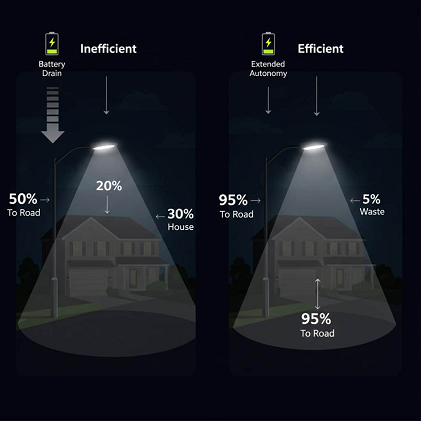
Where does the light go? In a poorly designed system using generic flood lenses, up to 30% of the light spills backwards (house-side) or upwards (sky glow).
From an energy perspective, this is a disaster. It means 30% of your battery capacity is being used to illuminate the birds and the grass, not the street. Advanced custom LED optical design utilizes Asymmetric TIR (Total Internal Reflection) technology to “cut” the light. It strictly confines the beam to the roadway width. By redirecting that wasted 30% back onto the road, you can lower the total wattage of the fixture. A 40W fixture with precision optics can often replace a 60W fixture with generic optics, drastically reducing the battery load.
Factor 3: Uniformity Allows for Aggressive Dimming (H2)
Most solar controllers use “Time Control + Dimming” profiles (e.g., 100% brightness for 4 hours, then 30% until dawn). The problem with cheap optics is “Hot Spots.” If the lens creates a bright spot in the center and dark edges, then when the light dims to 30%, the edges become pitch black and unsafe.
High-uniformity optics spread the light evenly. This allows the system to run safely at lower power levels (e.g., 20% or 25%) during late-night hours because the visual coverage remains complete. This ability to run at deeper dimming levels without compromising safety is a hidden lever for extending battery life.
Factor 4: Material Aging and the Efficiency Drop (H2)
Solar lights are installed in high-UV environments. If the optical lens yellows after 2 years, its transmittance drops significantly. To maintain the original brightness with a yellowed lens, a smart controller (with Constant Lumen Output, or CLO) would have to increase the power to the LEDs, draining the battery faster as the fixture ages.
Using UV-resistant materials from a supplier with a diverse range of optical products ensures that the transmittance stays high for 10 years. This means the battery load remains predictable and stable over the entire project lifecycle, preventing premature blackouts in older installations.
Conclusion (H2)
So, can you extend autonomy without buying a bigger battery? The answer is a resounding yes.
In the high-stakes game of Solar Lights Street Lights, efficiency is the currency. By treating the optical lens not as a piece of plastic, but as a power-saving device, engineers can build systems that are lighter, cheaper, and more reliable. Before you upgrade the battery, upgrade the optics.